

When your chest feels tight, or your child's fever refuses to break, the only thing louder than the symptoms is the question running through your mind. Where do you go? A trip to the emergency room (ER) for something manageable can turn into hours in a waiting room and a hefty bill. But when something is truly serious, waiting for an opening at your primary care provider simply won't do.
Choosing between the ER, urgent care and primary care shouldn't feel like a guess. The right choice usually comes down to a handful of clear symptoms and situations, so you can act with confidence instead of second-guessing yourself in the moment.
Healthcare Facility Comparison
Here is a quick comparison of primary care vs. urgent care vs. emergency room costs, wait times and hours:
| ER | URGENT CARE | PRIMARY CARE | |
|---|---|---|---|
| WHEN TO GO | Life-threatening or rapidly worsening conditions | Non-life-threatening illnesses or injuries that need prompt care | Ongoing health management |
| COST | Most expensive | Moderate cost | Lowest cost option |
| WAIT TIME | Several hours, depending on the severity of your condition | 20 to 30 minutes | Book days or weeks in advance |
| OPERATING HOURS | 24 hours a day, seven days a week | Extended hours and weekend availability | Standard business hours |
Emergency Room
The emergency room exists for the moments when speed and advanced resources make the difference. As part of a hospital, the emergency room carries the infrastructure for the highest-stakes situations, from advanced imaging to specialists on call around the clock. Doctors can also admit patients directly when needed.
Some symptoms call for immediate emergency attention. Go to the emergency room if you or a loved one shows any of the following signs:
- Chest pain, pressure or tightness that comes on suddenly
- Signs of a stroke, such as sudden facial drooping, arm weakness, slurred speech or vision loss
- Difficulty breathing or shortness of breath at rest
- Severe abdominal pain that appears without warning
- A serious head injury, loss of consciousness or sudden confusion
- Signs of a severe allergic reaction, such as throat swelling, widespread hives or a sudden drop in blood pressure
- Bleeding that won't stop, even with firm pressure
- A suspected broken bone with visible deformity or an open wound
- A first-time seizure or one lasting longer than five minutes
- A high fever paired with a stiff neck, rash or trouble breathing
- Suspected poisoning or a medication overdose
ER Pricing and Insurance
Emergency care carries the highest price tag of the three options. The average visit costs about $1,405, climbing further for cases requiring imaging, specialists or an overnight stay.
An ER visit is often at least partially covered by insurance, but usually with a higher copay and deductible.
ER Availability
Emergency rooms stay open 24 hours a day, seven days a week, so a crisis at 3 a.m. gets the same response as one at noon. That constant availability comes with a trade-off, as many patients wait several hours to get a bed. Non-critical cases often wait the longest.
Primary Care
Primary care rounds out the picture by covering the health needs that build gradually over time. A primary care provider helps you optimize and manage your long-term health rather than treating a single visit. They know your history and handle preventive screenings and specialist referrals.
Many health needs don't require a walk-in visit at all. See your primary care provider if you or a loved one has any of the following:
- An ongoing condition to manage, such as diabetes, hypertension or asthma
- A routine physical, wellness exam or annual screening
- A need for a referral to a specialist
- Symptoms that developed gradually over days or weeks
- Questions about a medication or its side effects
- A need for mental health support, counseling referrals or medication management
- Recurring headaches, fatigue or other persistent nonemergency symptoms
- Recent lab work or imaging results that need review
- A new symptom that's hard to categorize on your own
- Questions about preventive care, lifestyle changes or family health history
- A need for vaccine schedules or catch-up immunizations
- A well-child visit or developmental screening
- Concerns about a child's growth, development or behavior
Primary Care Pricing and Insurance
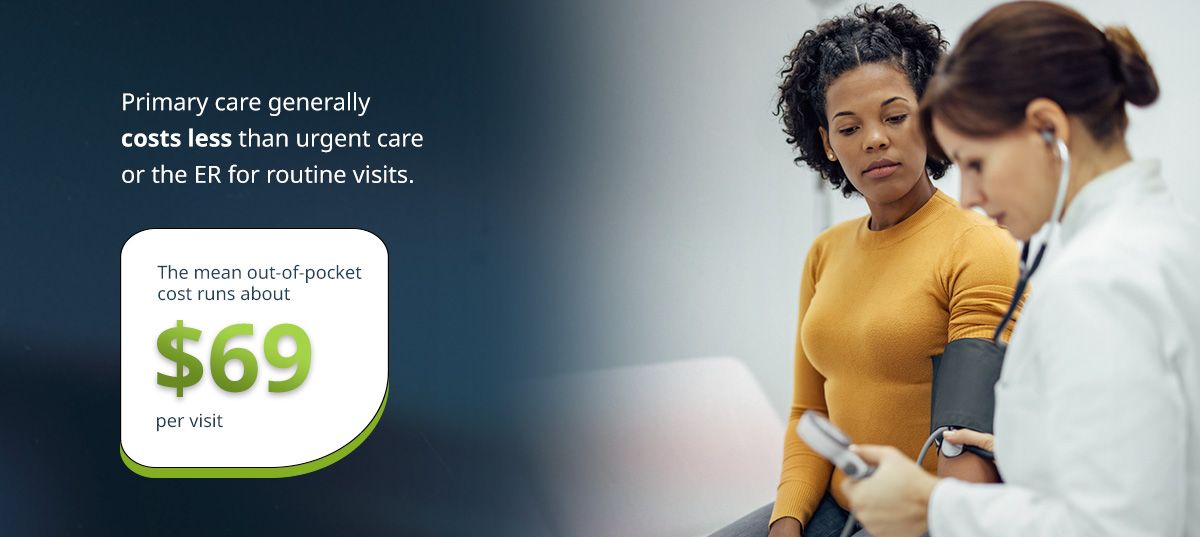
Primary care generally costs less than urgent care or the ER for routine visits. The mean out-of-pocket cost runs about $69 per visit, and most plans apply their lowest copay tier here.
Primary care typically has the lowest insurance copay for in-network visits, making it a dependable option for non-time-sensitive care.
Primary Care Availability
Primary care offices generally follow standard business hours and require appointments to be booked days or weeks in advance. That works for planned checkups, but leaves a gap when something comes up that can't wait.
Urgent Care
Urgent care handles the broad middle ground of health needs that require quick attention but not a hospital visit. It fills the gap between the ER and a primary care office, treating more than 185 million patients each year. You can walk in for advanced care without hospital-level overhead, backed by on-site labs and X-rays for same-day results.
A wide range of everyday injuries and illnesses fall squarely within urgent care's reach. Go to urgent care if you or a loved one has any of the following:
- A minor cut that may need stitches, with the bleeding under control
- A fever without other serious symptoms
- A suspected sprain, strain or minor fracture
- Symptoms of a urinary tract infection
- A mild to moderate asthma flare-up
- Ear pain, sore throat or sinus pressure
- A skin rash, minor burn or insect bite that is worsening
- A need for rapid strep, flu or COVID-19 testing
- Vomiting or diarrhea that is concerning but not severe
- A mild allergic reaction, such as hives without throat swelling
- A foreign object stuck in the nose or ear
Urgent Care Pricing and Insurance
The cost of urgent care typically lands well below the ER. Most centers use flat-rate or per-visit pricing, which keeps costs predictable no matter what symptom brings you in. Some centers, like NeuMed Modern Urgent Care + IV Therapy, charge a flat rate of $159 per visit, so you can plan for the expense before you arrive.
Urgent care is widely covered by insurance, though it's worth confirming whether the facility you plan to visit is in network and accepts your policy.
Urgent Care Availability
Urgent care wait times typically run 20 to 30 minutes, a fraction of the average ER wait. Most locations also extend their hours into the evenings and on weekends, which matters when a sprained ankle occurs after your doctor's office has closed for the day.
Why Urgent Care Is Often the Right Middle Ground
Think about the moments that don't wait for a convenient time. A hard fall on a Saturday morning, a fever that climbs through a weeknight or a child's ear that starts aching at 7 p.m. on a school night all call for care right away. Weighing between urgent care vs. primary care usually isn't a close call here, since one welcomes walk-ins the moment you need them and the other runs on a schedule.
The same logic applies to urgent care vs. the emergency room for anything short of a true emergency. Choosing urgent care means skipping hospital-level overhead for a condition that doesn't require it, so you spend less time waiting and more time getting back to your day.
Visit NeuMed Modern Urgent Care + IV Therapy

When chest pain, a stubborn fever or a nagging worry has you searching for the right place to go, NeuMed Modern Urgent Care + IV Therapy offers a straightforward option in Houston. Walk in any day of the week, and count on our team for prompt and compassionate care. NeuMed accepts most major insurance plans and offers transparent flat-rate pricing so you always know what to expect before you walk through the door.
When you are ready, book your visit online and get the care you need today.