

When your child isn't feeling well, the clock feels like it's moving in slow motion. Should you call the pediatrician and wait for an appointment? Head to urgent care for same-day attention? Or is this serious enough to go to the emergency room? This guide helps you make that decision with confidence, so your child gets the right care at the right time.
Urgent Care, Pediatrician or ER?
Knowing when to take a child to urgent care, schedule a pediatrician visit or head to the ER comes down to choosing the care setting that best matches your child's symptoms. Here's a quick comparison to help you decide:
- Urgent care: Nonemergency illness and injury that needs same-day attention
- Pediatrician: Routine, preventive and follow-up care
- Emergency room: True emergencies and life-threatening conditions
Approximately 33% of people in the emergency room are seeking help for non-urgent matters — and with ER care costing an estimated 10% more than urgent care, it's important to know the difference. The sections below expand on each option with specific scenarios to guide your decision.
When to Take Your Child to Urgent Care
Pediatric urgent care is the accessible middle ground for when the pediatrician can't see your child the same day. It is typically less expensive and faster than the ER. Look for centers that are open seven days a week with extended hours.
Here are common urgent care symptoms of kids that may warrant a same-day visit:
- Fever in an alert, hydrated child: If the child is drinking fluids, responding normally and otherwise acting like themselves, urgent care can generally evaluate and treat without an ER wait.
- Ear pain or a suspected infection: Ear infections are a common reason young children visit the doctor, and urgent care can often diagnose and treat on the spot.
- Sore throat, suspected strep or respiratory infection: Rapid strep testing can deliver fast results, so kids get the right treatment sooner. Choosing urgent care for common childhood illnesses helps you avoid long waits when your child is uncomfortable.
- Pink eye, skin rashes or mild infections: These are contagious, uncomfortable and best treated quickly without warranting an ER visit.
- Vomiting or diarrhea with mild dehydration: This applies when the child can still take in fluids and isn't severely lethargic. On-site labs can assess hydration quickly.
- Sprains, minor fractures, cuts or minor burns: On-site digital X-rays for suspected fractures and same-visit stitching for lacerations mean no ER trip required for most nonemergency injuries. Compassionate urgent care for injuries helps kids feel like themselves again.
When to Stick With Your Child's Pediatrician
Your child's pediatrician holds their full health history, and that continuity matters for long-term health. Here are scenarios that belong with the pediatrician:
- Annual well-child visits and routine checkups: The pediatrician's irreplaceable role is tracking growth, development and patterns over time in ways that urgent care can't replicate.
- Scheduled vaccinations and immunizations: Keeping your child's vaccine schedule on track requires the coordination and records that your pediatrician maintains.
- Developmental screenings and growth monitoring: Milestones, speech concerns and weight patterns require your child's full health history for accurate interpretation.
- Follow-up care after illness or injury: After an urgent care or ER visit, the pediatrician helps support complete recovery and flags anything that needs further attention.
- Recurring concerns: When a pattern develops, like repeated ear infections or seasonal allergies, the pediatrician is best positioned to identify the underlying cause and coordinate specialist referrals.
- Long-term management of chronic conditions: A consistent care plan and monitoring are essential for ongoing health conditions like asthma or nutritional deficiencies.
NeuMed offers family medicine services for ongoing care needs, combining the convenience of our walk-in model with continuity when you need it.
When to Go Directly to the Emergency Room
Knowing the signs of serious illness in children helps protect your child, your time and your finances. The ER is the right choice for true emergencies, and recognizing the difference helps you respond appropriately without hesitation.
Here are a few cases that require emergency care:
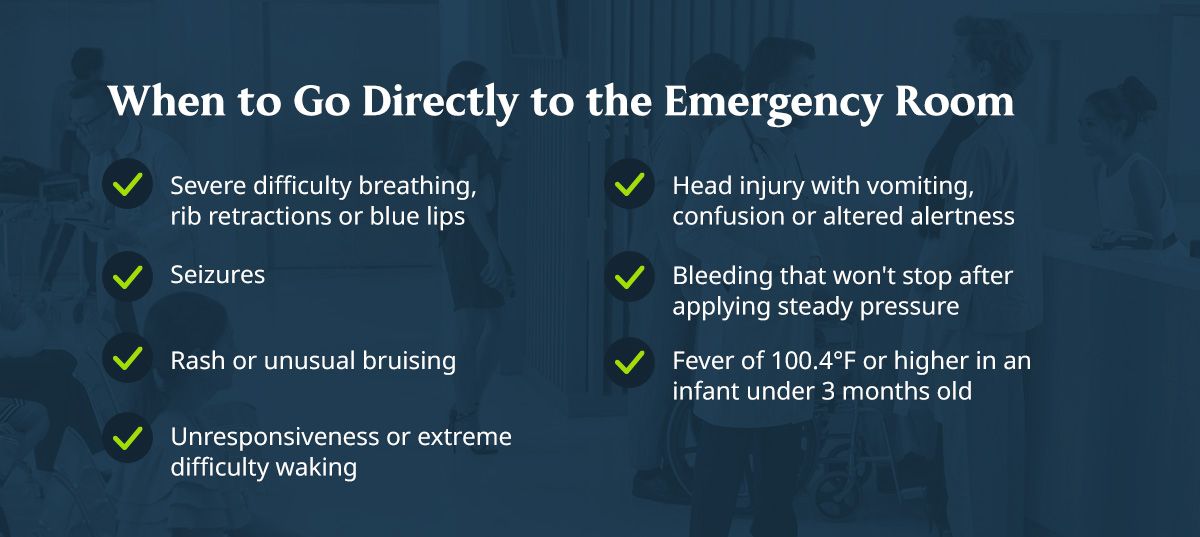
- Severe difficulty breathing, rib retractions or blue lips: If your child is struggling to breathe or showing signs of oxygen deprivation, call 911 or go to the ER immediately.
- Seizures: Any seizure in a child with no prior history or a seizure that won't stop requires emergency evaluation right away.
- Rash or unusual bruising: Fever accompanied by unexplained rash, bruising or other markings could be an emergency.
- Unresponsiveness or extreme difficulty waking: A child who can't be roused or is unusually unresponsive needs immediate emergency care. Call 911.
- Head injury with vomiting, confusion or altered alertness: After any significant head impact, these symptoms signal a potential concussion or more serious injury. Go to the ER.
- Bleeding that won't stop after applying steady pressure: Deep wounds that won't clot require emergency wound care and shouldn't be treated at urgent care.
- Fever of 100.4°F or higher in an infant under 3 months old: This threshold, regardless of how alert or calm the baby appears, always warrants immediate medical attention.
If you're ever unsure, going to the ER is always the right call. For nonemergency situations, NeuMed's team can help you get the right care fast.
How to Assess Your Child's Symptoms
Here's a practical rule of thumb. If a child is playing, drinking fluids and responds normally after a fever reducer, they can usually be monitored at home. If they're extremely lethargic, not improving or showing other concerning symptoms, contact their pediatrician and visit an urgent care or ER if necessary. It helps to monitor your child for any patterns, especially if they have a fever. If their temperature trends downward, it's usually a good sign. Fevers that continue to increase require medical attention.
Remember to mention your child's symptoms or fever at their next pediatrician appointment, even if they were minor or managed successfully at home. This information is helpful for tracking larger health trends and developments.
Visit NeuMed Modern Urgent Care + IV Therapy for Your Child's Care

NeuMed's pediatric urgent care is your trusted bridge between the pediatrician's office and the ER. We're open seven days a week from 8 a.m. to 8 p.m., with average visit times of just 20 to 30 minutes. We accept multiple insurance plans and treat children 6 months and older. For ongoing care needs, explore NeuMed's family medicine services. Feel free to walk into any of our locations or book an appointment online, and get your child feeling better, fast.
Get in touch with us online or call us at 832-879-2450 for any questions or to schedule an appointment.